February 2026 Newsletter

Happy Black History Month!
At DERT we know that the climate justice movement as it stands today would not exist without the efforts and sacrifices of our fellow Black activists. We would like to share with you the following article from the The Kregse Foundation.

Five Black leaders redefining climate action by centering equity, health and justice
Written for The Kregse Foundation by: Katharine McLaughlin
Climate change doesn’t affect everyone equally. And the people closest to the problem are often closest to the solution.
Across the country, Black leaders are driving bold, community-rooted approaches to climate resilience and challenging the systems that have long placed environmental burdens on the communities least responsible for creating them. They are scientists and organizers, policy shapers and coalition builders. They are redefining what climate leadership looks like by centering equity, health and justice in every strategy they advance.
In honor of Black History Month, we spotlight five leaders whose work sits at the powerful intersection of climate action and racial equity and ask for reflections on their life and careers. Their efforts span clean energy access, flood resilience, public health and beyond, and they share a common conviction: that the communities most impacted by environmental harm must lead the way forward.
Thank you for your Executive Director applications!
DERT has been on the hunt for a new Executive Director as we go into 2026. Applications closed on Feb. 20th - so thank you to everyone who applied! We are excited to announce our new ED in the coming weeks.
Dismantling Racism in Education
Written By: Phoebe Cross
DERT recently had the opportunity to attend a “Dismantling Systemic Racism in Education” presentation at the Washington Center for the Performing Arts, hosted by the Hawk Foundation, with keynote speaker Dr. Joy DeGruy. Dr. DeGruy is a deeply respected researcher and educator whose work explores the long-term impacts of historical trauma and the pathways toward healing and change. The evening was thought-provoking and emotionally impactful. It offered a powerful reminder of how history continues to shape present-day systems and experiences, and showcased a critical truth: when we downplay, or refuse to confront, the histories that have shaped our present, we limit our ability to move toward meaningful healing.
Dr. Joy DeGruy’s presentation highlighted the importance of engaging with complex, and often uncomfortable, truths as a necessary part of growth. She reinforced that meaningful change begins with both awareness and taking the time to deepen our understanding of the systems that shape our communities. Creating space for these conversations, especially within our professional and educational work, is a critical step toward building more informed, compassionate, and resilient communities.
What stayed with me most was a renewed understanding that social justice and environmental work are deeply interconnected. The systems that shape how people are treated are often the same systems that influence how land, wildlife, and natural resources are valued and protected. Recognizing these connections is essential if we want to create a more just and sustainable future– one that supports both healthy communities and healthy ecosystems.
SITE TOUR & OPEN HOUSE
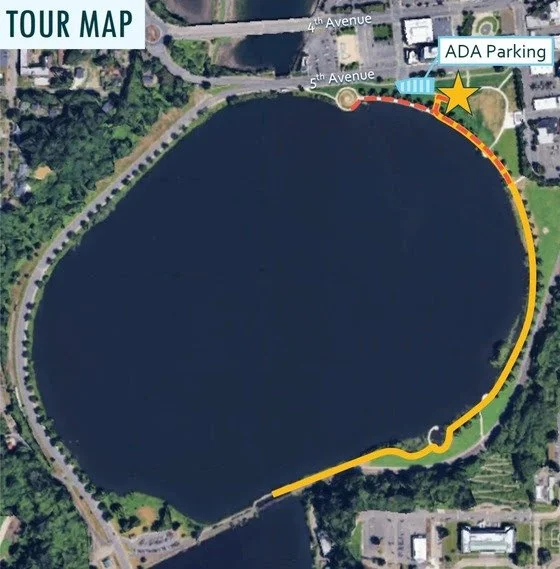
Join us on March 7, 2026, for a tour of the site and hot chocolate—rain or shine. The project team will share details about the existing conditions impacting Capitol Lake and our plans for how this expansive habitat restoration project will fit into the urban landscape.
The ADA-accessible tour will begin at the northern end of Heritage Park and will travel along the paved pathway adjacent to the lake. More details on this event are available at this link.
Site Tour & Open House
Mar. 7, 2026 10 AM – 2 PM
Tours will leave every 30 minutes starting at 10:05 AM
Shorter, family-focused tours available at 10:35 AM and 12:35 PM
Olympia Ecosystems appeals City’s SEPA Determination of Non-Significance
From Olympia Ecosystems' February Newsletter
As many of you know, Olympia Ecosystems has been tracking the proposed West Bay Yards (WBY) development at West Bay for the past seven years.
If you are new to the area, the proposed WBY project, which is located on Budd Bay shoreline within the Deschutes Estuary, involves the construction of 478 market-rate housing units and an additional 20,500 square feet of commercial space on 1,500 feet of highly contaminated shoreline. The project entails the importation of a staggering volume of fill, a repositioning of the ordinary high-water mark, and the creation of new uplands in violation of the Shoreline Master Program, all resulting in the total remaking of the West Bay shoreline, with significant impacts to traffic, water quality, and aquatic habitat. It would be the single largest housing development in the history of Olympia.
Despite clear indications that these impacts are significant, the City has issued a determination of non-significance (DNS), a legal designation under the State Environmental Policy Act (SEPA) that requires no mitigation and no public input, save for a pro-forma solicitation of comments. This is a pattern of public policy that has been on display for decades in Olympia and ultimately shuts out the community from decision making that affects all of us. Our comments to the City may be read here.
In response to this shocking decision, Olympia Ecosystems has reluctantly taken on the legal and financial burden of appealing the City’s decision. Our notice of appeal may be read here. Effective prosecution of this case will require tens of thousands of dollars in legal fees for lawyers and expert testimony. For that, we need your help.
To be clear, Olympia Ecosystems is not saying an absolute no to any development along West Bay. Rather, we are saying that the impacts of the WBY proposal would be significant under SEPA, and that therefore both mitigation and public participation through an environmental impact statement (EIS) are required. To be sure, an EIS may very well lead to a preferred alternative proposal with a reduced building footprint, resulting in reduced impacts to the environment and to traffic. These are legally defensible demands that we hope will be recognized and incorporated into a final preferred alternative.
Our promise to our supporters is to continue to be transparent every step of the way and to advocate in a way that is effective and practical.
Sediment Sampling Update:
West Bay Testing Results and Third Round of Sampling Set for March
Written for the Port of Olympia by: Jonathon Wolf, Environmental Manager
The Port of Olympia began testing for historic contamination in Budd Inlet in 2024 under an Agreed Order with the Department of Ecology. Although the Port is leading the investigation of Budd Inlet sediment contamination, it is expected that other liable parties will be identified as we continue the investigation.
Over the past two years, Port scientists and research crews have worked diligently to conduct a thorough investigation, collecting thousands of sediment samples in East and West Bays. We recently shared results from our first round of testing in East Bay and are now ready to share the results from our second round of testing in West Bay.
West Bay Sediment Testing
In January 2025, our research team conducted two months of sediment sampling in the West Bay of Budd Inlet. This included the area from the 5th Avenue Bridge up to West Bay Marina and east to the peninsula.
Like previous sediment testing in East Bay, sediment samples were collected from different locations and depths to get a clear picture of sediment conditions:
Surface samples – from the top layer of mud and debris.
Intertidal samples – from areas exposed at low tide.
Subsurface samples – from deeper layers below the surface.
Encouraging Results
Sediment samples were sent to labs in Washington and California where they were analyzed by a highly specialized team of marine experts, project consultants and scientists. The results, while not final, have been reviewed and we are encouraged by the results.
We found surface dioxin and furans above screening levels in two areas: in scattered locations at the north end of the testing site and under the marinas to the south. Most of the samples came back at less than twice the screening level.
This is good news. In many cleanup projects, levels can be 10, 100, or even 1,000 times higher than the screening level. What this means is that the low levels detected in West Bay do not pose a major threat to marine life or human health. It also potentially means less dredging will be necessary and we can allow Mother Nature to do much of the work through natural recovery.
As with the dioxin and furans, we also found relatively low levels of polycyclic aromatic hydrocarbons (gas and diesel) in the following four areas. Once again, we are hopeful that lower levels could mean reduced dredging and cleanup costs in the future.
Under West Bay Marina
Along the western shoreline consistent with outfalls
Under the Marine Terminal berth
Under the private marinas along Percival Landing.

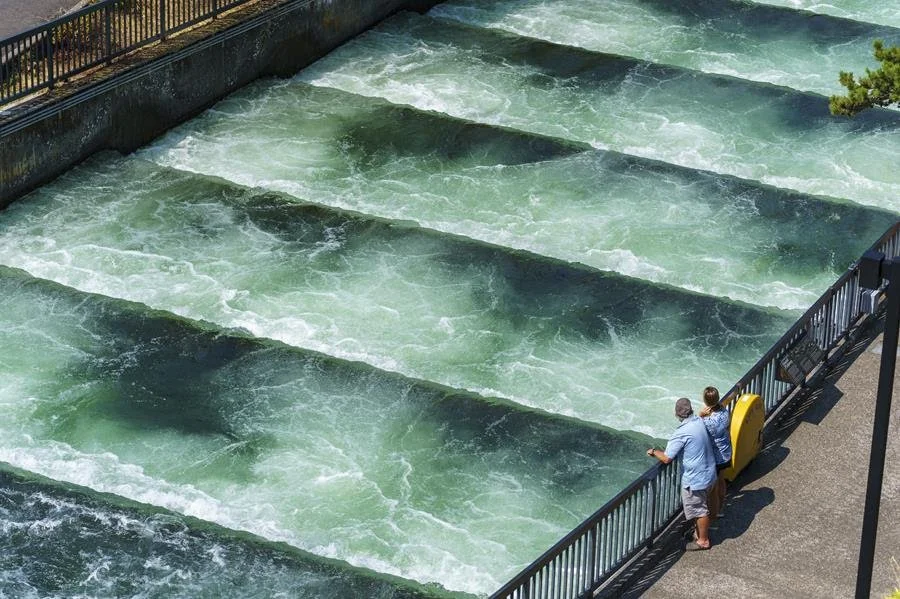
Judge orders protective measures for Columbia River salmon after Trump canceled historic deal
Written for Oregon Public Broadcasting by: Tony Schick
A federal judge in Oregon has ordered dams that operate on the Columbia and Snake rivers to generate less hydropower and allow more water to pass in an effort to keep salmon populations from dying out.
The order largely restores measures that were in place under a landmark deal to protect salmon that the Trump administration canceled last year.
U.S. District Court Judge Michael Simon yesterday granted many of the changes that environmental advocates, tribes and the states of Oregon and Washington sought in their decades long lawsuit over the federal government’s operation of dams on the Columbia and its largest tributary, the Snake.
Simon’s preliminary order is the first major change to dam operations since Trump’s actions reactivated the case, which has its roots in endangered species listings for multiple salmon and steelhead populations in the Columbia River basin more than three decades ago.
And the latest legal twist comes at a critical time for both salmon and energy in the Pacific Northwest. (Tony Schick)