December 2025 Newsletter
Happy Holidays from DERT!
The DERT Board & staff celebrated a lively and impactful year at our December Board Meeting. We reflected on where we've been, what we've accomplished, and where we're headed as an organization. We want to extend our sincerest gratitude to you all for joining us at our many events this last year, including CEDE workshops and our first ever Deschutes Watershed Symposium. Wow!
It has been a joy to grow our partnerships & relationships, work toward a truly sustainable future in the Deschutes Estuary, and to make so many new friends along the way. Cheers to you all and happy holidays!
We would like to give a special thank you to the Harry and Elsie Weiner Donor Advised Fund of the Jewish Federation of Greater Seattle. Just in time for the holidays, they gifted DERT a $4,000 grant in memory of Marvin Reiner.
As their letter to us said, this money is going to "where it is needed most."
Have you done your Year-End-Giving?
Don't forget to make your charitable contributions to DERT before the end of the year. When you give to DERT, you are supporting ——>
Enhanced Deschutes estuary & watershed stewardship
Meaningful community engagement
Internship programs & skill building
Citizen science & youth involvement
Strong partnerships & community development
A voice for a free flowing Deschutes
Our Year in Review
The First Annual Deschutes Watershed Symposium
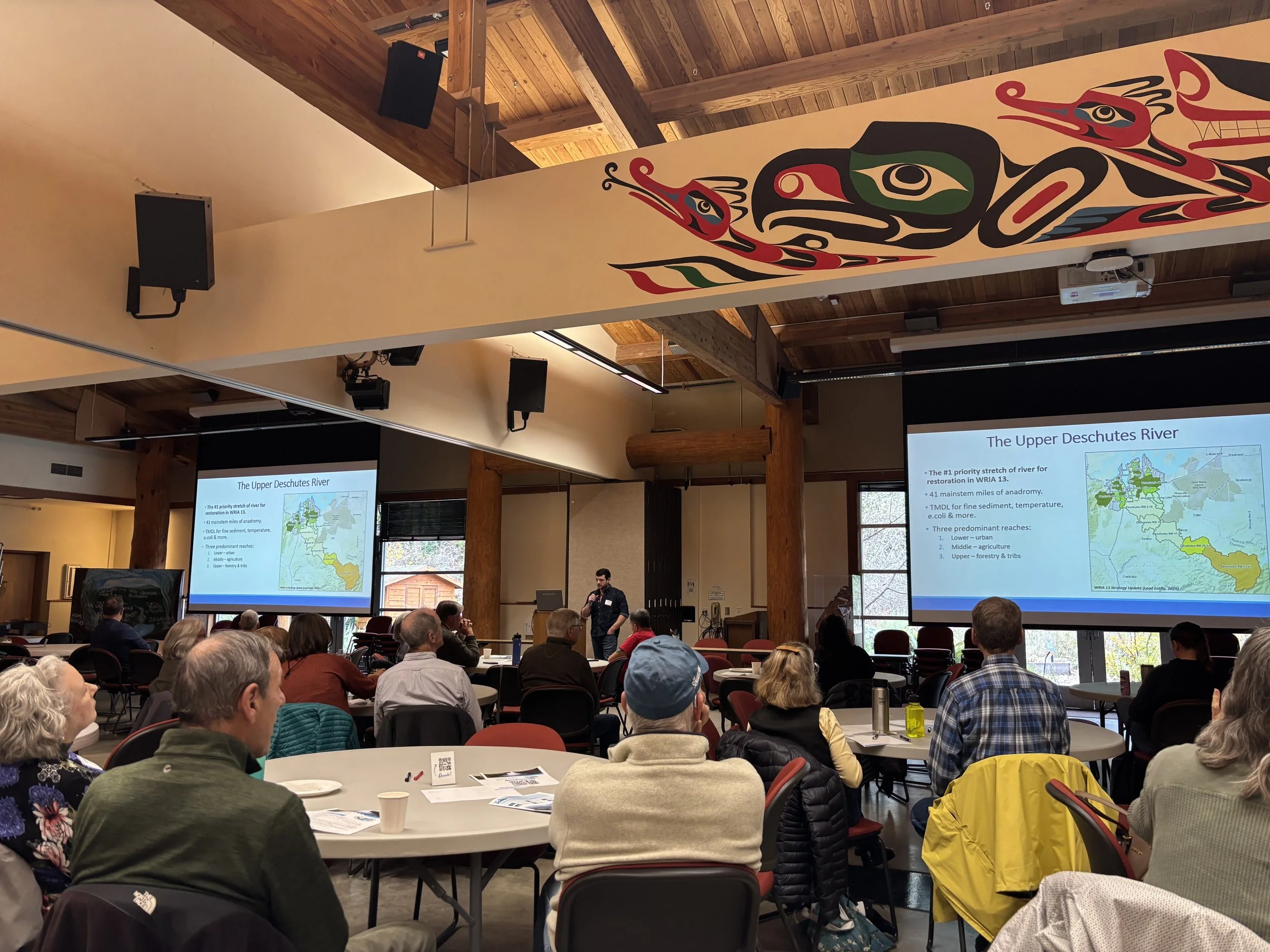
What we hope is the first of many, the Deschutes Watershed Symposiums was a great success. With nearly 100 people in attendance, the day was met with enthusiasm from both the crowd and our presenters.
We have so many people to thank for pulling this one off, but we want to start with the presenters. Thank you for bringing your expertise, energy, and curiosity to the Watershed Symposium. The day was as compelling as it was because of each and every one of you! Your presentations helped create a grounded, science-driven picture of what’s happening across the watershed, and the attendees gave us incredibly positive feedback!
We would also like to thank our partners at the Washington State Departments of Ecology and Enterprise Services. Not only did they provide and coordinate the facilities for the day, but they also provided a very important update on the Deschutes Estuary Restoration Project. We look forward to continued partnership with them as we work together to realize a fully restored Deschutes Estuary.
Lastly, if you didn't make it out in November and are still interested in the info that was shared, keep an eye on our website! We are working with our presenters to upload their slides to the site so this important information is accessible to everyone.
Community Envisioned Deschutes Estuary (CEDE)
Winter 2025
This series was centered around themes expanding beyond the physical design of the restored Deschutes, including sustainable development, education, pollution, and stewardship. Each forum began with a brief lecture or panel, and then expanded into compelling community discussion. Local artist Carrie Ziegler performed graphic note-taking throughout the series, and will produce a final painting of our collectively defined vision for a restored Deschutes Estuary community. The work was displayed and shared with the public at Spring Arts Walk 2025.
Intro – January 14
At the introduction to the CEDE series, we heard from Kris Peters of the Squaxin Island Tribe on the history of the Deschutes Estuary and Squaxin Island Tribal connection to that landscape. We also heard from Tessa Gardner-Brown of the Deschutes Estuary Restoration Project (DERP) team about the process and plans for the estuary restoration. DERT founder Sue Patnude then set the stage for the series through breakout group discussions on a big question: How do we want to define a sense of place in a restored Deschutes Estuary? Some of the major themes we heard included expanding access, enhancing connection with the land, situating the estuary restoration in space (in the watershed) and time (history, present moment, future), building more relations with our neighbors, and developing culture and tradition associated with the landscape.
Sustainable Development – January 28
Facilitated by DERT’s own Ray Willard, the Sustainable Development workshop introduced a watershed-wide approach to how we might consider our future of living alongside a restored Deschutes Estuary. We were joined by guest speaker Justin Hall of the Nisqually River Council, who shared a neighboring perspective on improving stewardship efforts through a non-regulatory collaborative approach. Group discussion centered around building a vision for what a sustainable future looks like in the Deschutes Watershed 50 years from now. Major themes we heard included developing in line with the watershed’s carrying capacity, creating more non-car transportation opportunities and connecting trail networks, and living in a future with consistent and accessible education opportunities linked to restoration and recreation. We also discussed preserving rural and agricultural landscapes and implementing more Green-Blue infrastructure.
Education – February 11
During our Education workshop, we were fortunate to have Stephanie Bishop of the Thurston Conservation District (TCD) facilitate an evening spent exploring the current landscape of environmental education in the Watershed and opportunities for the future. She brought in partners to speak to their unique enviro ed focus areas, including Aimee Christy of the Pacific Shellfish Institute, Matthew Phillipy of Marshall Middle School’s Citizen Science Institute, Anthony Terzoli of the Estuarium, Sam Nadell of TCD’s South Sound GREEN, and Michael Joseph of The Evergreen State College’s Center for Climate Action and Sustainability. Stephanie then let participants self-select into breakout groups centered around either non-formal ed, formal ed, adult engagement, and youth engagement. We discussed what programming is happening, what’s working well, and what’s currently missing. As a group, we learned that there is a need for both a centralized meeting and education space (for youth & adults) and for a centralized aggregate calendar and resource center for environmental ed offerings.
Pollution – February 25
DERT’s own Grant Gilmore facilitated a watershed-wide discussion on pollution issues and management. We were joined by Dave Kangiser of the City of Tumwater, Cole Baldino of DERT and the South Puget Sound Salmon Enhancement Group, Stephanie Bishop of Thurston Conservation District, Kane Osstifin of the City of Olympia, and Jonathan Wolf of the Port of Olympia. Our guests gave a highly informative overview of pollution management issues in each section of the watershed. Collectively, we learned A TON about stormwater, what contributes to pollution, and effective management strategies. Group discussion identified further strategies to pursue for enhancing watershed health, including bioremediation via rain gardens and bioswales, creative outreach, especially in the middle watershed, continued pressure for legacy pollution clean-up, increased general public education & outreach, increasing recreational opportunities to for fostering a sense of stewardship, and the importance of coalition building.
Stewardship – March 11
Facilitated by DERT’s Mackenzie Kleiva, the Stewardship workshop centered around perspectives and strategies of stewards both within the Deschutes and in neighboring watersheds. We heard from Paul Cereghino of the Society for Ecological Restoration and Salish Sea Platform, Daniel Einstein of OlyEcosystems, David Herrera of the Skokomish Indian Tribe Legal & Policy Department, Scott Steltzner of the Squaxin Island Tribe Natural Resources Department, Kirsten Joy Harma of the Chehalis Basin Partnership, and Shade Osuna of The Many Trees Project. We broke the fourth wall on stewardship and asked groups to discuss how they want to engage as stewards themselves. Recurring themes from guest speaker and participant discussions include relationship building as key, creating adaptable frameworks for funding and engagement ebbs & flows, a need for more hands-on opportunities, finding ways keep engagement momentum going, supporting existing groups, and building up a network and/or watershed council. Closing words from one of our founders, Sue Patnude: “If not for the relationships built in the early days of DERT, we wouldn’t be here [estuary restoration]. Bringing the Deschutes to the community and educating the people is a challenge, but it is so important that we educate people on the river.”
Future Action – March 25
In our final workshop of the series, the DERT Board of Directors engaged in a panel discussion, facilitated by Mackenzie Kleiva. They shared their interest in and experience working with DERT and their perspectives on the series and what we’ve learned. We also had the opportunity to receive 30% design updates from Tessa Gardner-Brown of the Deschutes Estuary Restoration Project team. Wind in our sails to hear about current progress in the estuary while strategizing about our future! As a group, we had the opportunity to ask the audience questions and allow for audience questions of the Board. Some of the key themes we discussed were empowered advocacy through knowledge sharing, encouraging science & monitoring, an interest in exploring tools for enhancing our political power, and the need to continue to stay focused on estuary restoration to ensure long term funding and appropriate stewardship.
Support for the CEDE program is provided by the Puget Sound Stewardship & Mitigation Fund, a fund enabled by the Waste Action Project and the Rose Foundation for Communities and the Environment.
Coming Soon:
An Updated Deschutes Watershed Guide!
DERT is excited to announce that a refreshed Deschutes Watershed Guide is in the works for 2026! Building on the beloved 2016 edition, this updated guide will highlight the unique ecology, history, and stewardship efforts within the Deschutes River Watershed. It will serve as both an educational resource and an invitation to explore and protect our shared home in new ways.
An Update from DERP!
PROJECT UPDATE
The Project Team is on track to complete 60% design by the end of 2025. In early 2026, the design will also be reviewed by project design partners, including the Squaxin Island Tribe, Washington Department of Fish and Wildlife, City of Olympia, and City of Tumwater.
We will plan to share updated visual simulations of the bridge, habitat areas, and Heritage Park shoreline with the community at upcoming events in 2026. Read on to learn more!
VIRTUAL PROJECT UPDATE MEETING — February 2026
Ecology will hold a virtual meeting on February 12, 2026. This will be an opportunity to meet the Ecology Project Team and get a brief update on the primary components of the project and planned activities for 2026. There will also be time for questions and answers with the Project Team. Additional information can be found on the project website.
Virtual Project Update Meeting
Feb. 12, 2026
5–6:15 PM
Meeting link below - no registration required
https://us02web.zoom.us/j/86729201188#
Join via audio: +1 253 215 8782 US (Tacoma)
Webinar ID: 867 2920 1188
Update on our website!
We will be taking down our website and email platform over the holidays to do some routine maintenance. In the meantime, you can contact us via Facebook or Instagram. We'll be fully back online in 2026!